Sharad Pawar and Supriya Sule, meeting PM Modi on Wednesday, discussed student concerns over the NEET leak, farmer issues, water management, and education sector problems. PM Modi assured positive measures on these issues. Amid speculation of NCP faction unification and joining the NDA, Sule paid tribute to Ajit Pawar on his birth anniversary.

A. Revanth Reddy, Telangana's Chief Minister, criticized the BJP government for suppressing democratic dissent during a protest against NEET examination irregularities. He accused Prime Minister Narendra Modi and Education Minister Dharmendra Pradhan of failing to protect students' interests and demanded Mr. Pradhan’s resignation. Protests led by Congress cadre across Telangana continued, with leaders staging dharnas in Hyderabad, Hanamkonda, Sangareddy, and Husnabad. The protests aimed to hold the government accountable for NEET paper leak allegations and Rahul Gandhi's arrest.

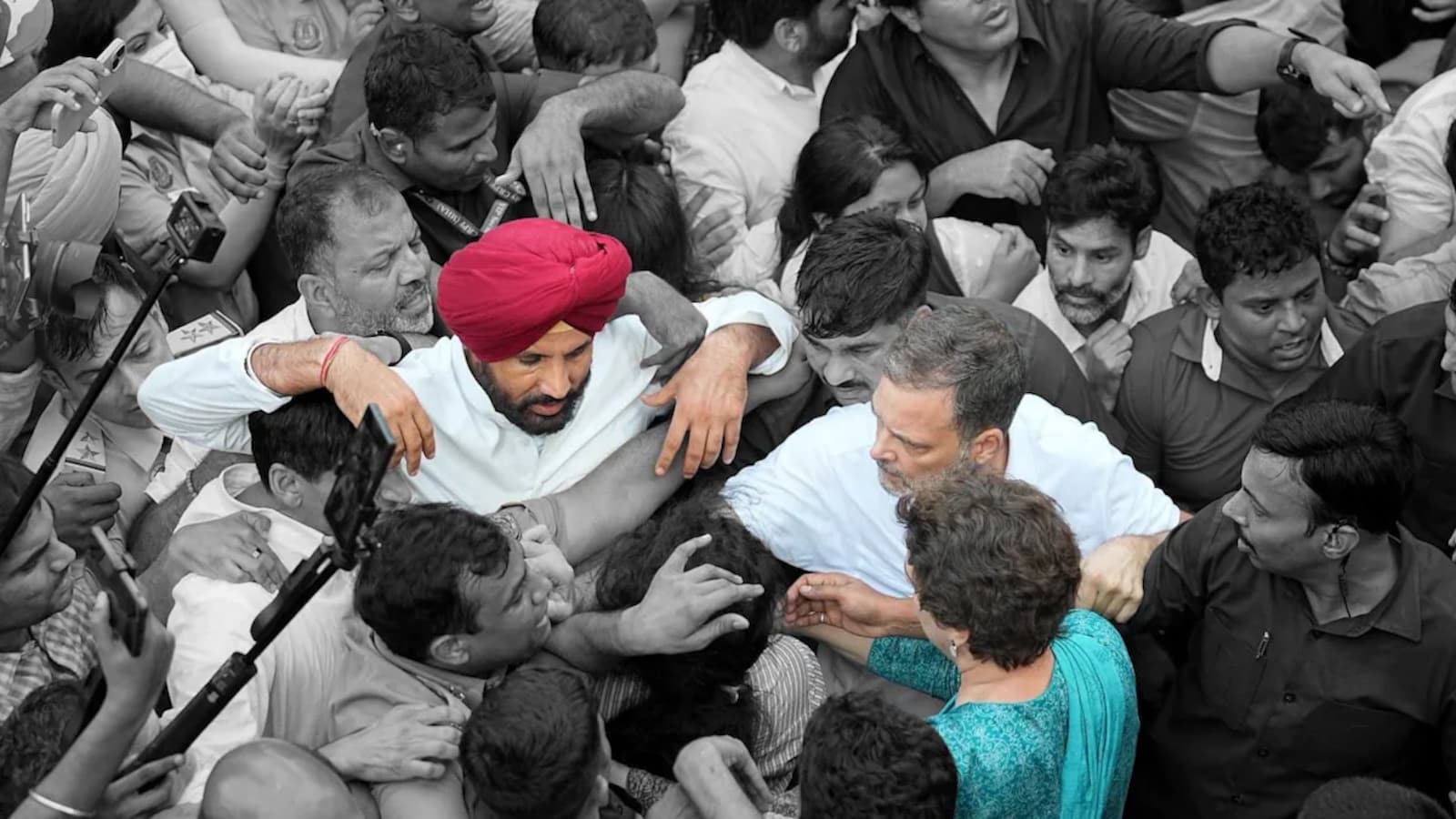
Sources told NDTV that Congress MPs thought they were invited to Mallikarjun Kharge's house for his birthday but were instead asked at the last minute to join a protest against paper leak issues. The march, led by Rahul Gandhi, Priyanka Gandhi Vadra, and Kharge, began around 3:15 pm and reached Prime Minister Narendra Modi’s residence. Police detained leaders including Rahul and Priyanka Gandhi and dispersed protesters by 7 pm.

On July 21, 2026, Omar Abdullah, Chief Minister and vice-president of the National Conference (NC), led a protest in New Delhi demanding restoration of statehood for Jammu and Kashmir to restore constitutional guarantees. The NC emphasized that without statehood, Article 370 loses its significance as union territories lack power-sharing abilities with the central government. Despite invitations to several national leaders, including Sonia Gandhi, only some Congress leaders joined due to chaotic conditions in Delhi. The protest was overshadowed by another march organized by the Cockroach Janta Party and missed by many INDIA alliance partners. Abdullah asserted that this is just the beginning of efforts to escalate the demand for statehood, emphasizing the need for clarity on when the central government will act on their word regarding restoration.

On July 19, T. Jagga Reddy, working president of Telangana Congress, criticized the language used by K.T. Rama Rao (BRS working president) against the Gandhi family, questioning its alignment with Telangana culture. Jagga Reddy referred to Sonia Gandhi’s role in forming Telangana and challenged KTR on his comments wishing harm upon Rahul and Priyanka Gandhi. He also highlighted the Congress government's employment initiatives under Revanth Reddy, contrasting it with alleged failures by the BRS leadership.

The Monsoon Session of Parliament begins on Monday amid tensions over exam paper leaks, activist Sonam Wangchuk’s hunger strike, and alleged theft at the Ram Temple in Ayodhya. The session comes as 37 MPs from four Opposition parties have shifted allegiance to the BJP-led NDA, bolstering its numbers but adding acrimony among opposition ranks. The government plans to reintroduce a legislative package on women's reservation and increase parliamentary strength, though it remains cautious due to shifting political dynamics. The Opposition, led by Rahul Gandhi, aims to corner the government over these issues, hoping to tap into voter discontent.

Chief Minister A. Revanth Reddy criticized the previous BRS government, alleging suppression of Telangana culture and democratic voices, including youth job seekers. He launched a foundation stone for the Andesri Smriti Vanam at Ghatkesar, honoring poet Andesri, while assuring unemployed youth that 70,000 government jobs had been filled under his Congress government. Published July 18, 2026.

On the eve of Parliament’s monsoon session, Opposition parties united to criticize the BJP government for moving activist Sonam Wangchuk from Jantar Mantar to Safdarjung Hospital while on a hunger strike. The Congress, AAP, and other opposition leaders accused the government of arrogance and repression, citing Delhi High Court directions that allowed the move due to health concerns.

On July 20, Omar Abdullah and the National Conference will protest at Delhi's Jantar Mantar to restore Jammu and Kashmir's statehood. The Congress, led by its central leadership including president Malikarjun Kharge and senior leaders Sonia Gandhi and Rahul Gandhi (if he joins), will support this demand, advocating for "Statehood Plus" which includes internal autonomy and constitutional guarantees for land and job rights.

On Friday, Pawan Khera, a Congress MP and senior leader, visited activist Sonam Wangchuk at Jantar Mantar in Delhi. Wangchuk began a hunger strike on June 28 to demand the resignation of Dharmendra Pradhan over exam paper leaks and wider education reforms. Following Sonia Gandhi's directive, Khera criticized the government for not understanding democratic protests and expressed concern about Wangchuk’s health. Several opposition parties support Wangchuk's demands.

On the 19th day of his hunger strike over the NEET controversy, Sonam Wangchuk received support from the Congress, led by general secretary K C Venugopal. Sonia Gandhi, despite some internal skepticism, directed the party to back Wangchuk, drawing a parallel to her mother Indira Gandhi’s 1984 intervention with Wangchuk's father. Meanwhile, at Jantar Mantar, an announcement slip-up introduced Samajwadi Party MP Dimple Yadav as “yuva MP Dimple Kapadia,” briefly lightening the mood. Additionally, UNION JAL Shakti Minister C R Patil launched a campaign distributing notebooks featuring PM Narendra Modi to promote water conservation among schoolchildren in Uttar Pradesh villages along the Ganga, particularly focusing on Varanasi.

On July 13, Sat Paul Sharma, BJP's state unit chief in J&K, issued a legal notice to Omar Abdullah demanding evidence for his "poaching" allegations against the BJP or a public apology within seven days. The BJP threatens a Rs 100-crore defamation suit if Omar fails to comply. Reacting, Omar termed the notice an "honour" and vowed to send legal notices to BJP leaders making slanderous accusations. This comes ahead of NC's statehood protests in Delhi on July 20, where they plan to invite several national leaders.

On Saturday, Omar Abdullah, Jammu and Kashmir's Chief Minister, accused the BJP of attempting to bribe an MLA with Rs 20-30 crore and a ministry to defect. He criticized delays in restoring statehood and scheduled a protest on July 20 at Jantar Mantar, inviting opposition leaders including Sonia Gandhi. BJP denied the allegations, calling them "unfortunate" and "misleading."

On July 10, 2026, the National Conference in Jammu and Kashmir urged leaders of INDIA bloc parties and local politicians to join their protest on July 20 at New Delhi’s Jantar Mantar for Statehood and constitutional guarantees. Meanwhile, BJP leader Sunil Sharma announced counter protests across J&K over employment issues on the same day. NC president Dr. Farooq Abdullah wrote letters to leaders including Sonia Gandhi and Mamata Banerjee seeking support. The protest aims to reclaim constitutional rights, while BJP claims NC is diverting attention from halted development and corruption.

Pranab Mukherjee, former President, praised Prime Minister Narendra Modi for his ability to understand the people's pulse. Sharmistha Mukherjee, daughter of Pranab Mukherjee, shared her father's diary entries and personal interactions with Modi, highlighting their cordial relationship that predated Modi's tenure as Gujarat Chief Minister. Mukherjee also emphasized the importance of dialogue in democracy, stating his belief that Parliament should not be obstructed by either party.

A Union Minister of State for Agriculture and Farmers' Welfare, Bhagirath Choudhary, received a Rs 99-lakh subsidy from a scheme under his own ministry. The scheme, "Development of Commercial Horticulture through Production and Post-Harvest Management of Horticulture Crops," promotes commercial farming of select vegetables and flowers. Choudhary's project, for cucumber cultivation, was approved by the National Horticulture Board (NHB), which is headed by the Union Agriculture Minister as ex-officio President and the Union MoS for Agriculture as ex-officio Vice-President. The scheme offers a maximum subsidy of 50% capped at Rs 1 crore per family.

The BJP responded to Sonia Gandhi's article criticizing the Modi government's stance on the Gaza conflict, accusing her of misinforming and concealing the truth about India's position. The ruling party asserted that India has consistently articulated its stand on the issue, provided humanitarian aid, and voted in favor of UN resolutions calling for a ceasefire. Shehzad Poonawalla, BJP national spokesperson, stated that India's actions demonstrate a commitment to all-alignment diplomacy and highlight Prime Minister Modi's ability to maintain ties with countries on opposing sides of global conflicts.

Wayanad Prakrithi Samrakshana Samithi (WPSS) and Coexistence Collective Kerala have accused vested interests of falsely portraying environmental activists as anti-farmer. The organizations claim these groups have launched a campaign against Coexistence Collective Kerala, alleging that they have historically supported the government's actions in relation to human-wildlife conflict, bamboo grove felling, acacia plantations, and clear-felling operations. They also note that these same individuals are now falsely portraying themselves as protectors of farmers and Adivasis while ignoring the government’s failure to provide adequate protection for them.
Maharashtra politics has a history of splits and alliances, dating back to the 1969 Congress split. The Shiv Sena, founded in 1966 by Bal Thackeray, has experienced multiple internal conflicts, including its alliance with the BJP for 25 years before shifting allegiances. Sharad Pawar's political career has been marked by splits from both the Congress and NCP, leading to the formation of new parties. In recent years, a series of rebellions within the Shiv Sena and NCP have resulted in significant power shifts, culminating in Eknath Shinde becoming chief minister after a 2022 rebellion. The current political landscape is characterized by ongoing disputes over party symbols and leadership, with Uddhav Thackeray's faction facing challenges to its control.

Sharad Pawar, leader of the Nationalist Congress Party (NCP), has revived his suggestion that regional parties could merge with or form closer associations with the Congress. Pawar's proposal gained traction after recent political developments, including the BJP's expansion and splits within opposition parties like the Trinamool Congress (TMC) and Shiv Sena. The Congress leadership remains wary of Pawar due to past disagreements, but a renewed sense of urgency has emerged as regional parties face challenges and the BJP seeks to consolidate its power. While a merger is considered attractive, it faces significant obstacles including logistical issues, worker acceptance, and potential resentment from those who left the party in the first place.

Congress has a history of producing breakaway parties that have become influential regional forces. The BJP, on the other hand, has seen its rebels return to the parent party or fade from political relevance. While some Congress splits led to powerful regional parties like the Trinamool Congress and NCP, the BJP's breakaways have generally been short-lived. Recent speculation about a merger between Congress and regional parties like the NCP and Trinamool Congress is unlikely due to concerns about power dynamics, bargaining ability, and organizational control.

C. Joseph Vijay, Tamil Nadu Chief Minister, visited President Droupadi Murmu at Rashtrapati Bhavan in New Delhi on Wednesday. He also met with Vice-President C.P. Radhakrishnan, Congress Parliamentary Party chairperson Sonia Gandhi, and Leader of the Opposition in the Lok Sabha Rahul Gandhi. Vijay's visit included discussions with leaders from various political parties, including the Communist Party of India (CPI) and its general secretary D. Raja.

Rahul Gandhi met with Abhishek Banerjee, national general secretary of the Trinamool Congress, in New Delhi on Wednesday, June 10, 2026. The meeting followed talks between Mamata Banerjee and Sonia Gandhi earlier that week. These meetings are part of efforts to strengthen unity within the INDIA alliance, which aims to present a united front against the BJP. Congress leadership is also holding internal meetings to discuss current political developments.

The Trinamool Congress is facing a severe internal crisis following resignations from senior figures and open rebellion. MP Sagarika Ghose stated that the party cannot exist without Mamata Banerjee, while criticizing the BJP for weaponizing state agencies to intimidate opposition members. Abhishek Banerjee met with Rahul Gandhi to discuss the INDIA bloc, while Sushmita Dev resigned from the Rajya Sabha and the party, expressing admiration for Himanta Biswa Sarma. Senior Trinamool figures dismissed speculation of a merger with the Congress.

Tamil Nadu Chief Minister C Joseph Vijay met with Sonia Gandhi and Rahul Gandhi in New Delhi on Wednesday. Vijay is attending the Niti Aayog governing council meeting on Thursday, marking his second visit to the capital since becoming chief minister in May. The meeting was a courtesy call, with the Gandhis wishing Vijay well for his future as chief minister.

Iran is retaliating against U.S. military facilities, escalating tensions in West Asia. The Congress is facing a battle over Meenakshi Natarajan’s Rajya Sabha nomination. Mamata Banerjee met with Sonia Gandhi.
Abhishek Banerjee, national general secretary of the Trinamool Congress, met with Rahul Gandhi, Leader of Opposition, for one and a half hours on Wednesday to strengthen coordination within the opposition INDIA bloc. The meeting followed Mamata Banerjee's meeting with Sonia Gandhi, where they discussed the need for greater unity against the BJP. The Trinamool Congress conveyed its desire for a strong alliance and accepted Rahul Gandhi's leadership, while Congress has made it clear that any merger proposal must come from them. This comes amidst internal rebellion within the Trinamool Congress, with some MLAs and MPs considering an alliance with the BJP.

Sushmita Dev, a former Congress leader and Trinamool Congress MP, resigned from the Rajya Sabha, citing personal reasons. She is the second Trinamool MP to resign this week following Sukhendu Sekhar Ray. Dev's resignation follows her meeting with Assam Chief Minister Himanta Biswa Sarma and her decision to support the BJP-led NDA government. The rebellion within the party has led to concerns about a potential split, potentially bringing the NDA closer to its two-thirds majority goal in the Lok Sabha.

Mamata Banerjee met with Sonia Gandhi in Delhi to discuss coordination among the INDIA bloc parties. The West Bengal CID conducted searches at the Trinamool Congress’s central party office and the office of its national general secretary, Abhishek Banerjee, as part of an investigation into alleged Assembly signature forgery. The TMC leader, Kalyan Banerjee, stated that the party is not worried about rebel MPs joining the NDA and maintains that their strength lies in "Maa, Maati and Maanush".

Kirti Azad, a Trinamool Congress MP, criticized rebel MPs who he called "traitors" and accused them of seeking power. He alleged that these individuals were being blackmailed and threatened with coercion to join the BJP. Mamata Banerjee, the party's chief, has vowed to rebuild the party and fight again on the streets. Azad also claimed that several rebels, including Kakoli Ghosh Dastidar, had been caught taking bribes and that they lacked loyalty to the party. He asserted that these individuals would not be able to win in future elections.

Mamata Banerjee, leader of the Trinamool Congress, met with Sonia Gandhi, chairperson of the Congress Parliamentary Party, at her residence in Delhi. The meeting followed a recent photo of their embrace at an INDIA bloc meeting and comes amid significant challenges for both parties, including rebellions within their ranks. Experts suggest that no major discussions took place without Rahul Gandhi, Leader of the Opposition, present.

Twenty-three Opposition parties, including the Congress, Samajwadi Party, and Trinamool Congress, met in New Delhi on Monday to address concerns about economic distress, inflation, and educational chaos. The bloc resolved to write to the Chief Justice of India over electoral fraud allegations, demand the resignation of the Union Education Minister, call for an all-party meeting to discuss the economic crisis, agree to hold coordination meetings every two months, and commit to daily parliamentary coordination during sessions. The meeting followed recent fissures within the alliance, including the absence of the DMK and the Aam Aadmi Party, highlighting the fragility of the coalition. Despite these challenges, there is a broad consensus on the need to checkmate the BJP for political survival and the health of Indian democracy.
Twenty-three Opposition parties, including Congress president Mallikarjun Kharge and Leader of the Opposition (Lok Sabha) Rahul Gandhi, met in Delhi on Monday to address concerns about economic distress, inflation, and educational chaos. The bloc resolved to write to the Chief Justice of India regarding electoral fraud, demand the resignation of Union Education Minister Dharmendra Pradhan, call for an all-party meeting to address the economic crisis, agree to hold coordination meetings every two months, and commit to daily parliamentary coordination. The meeting aimed to strengthen institutional framework for Opposition coordination and press the ruling Bharatiya Janata Party (BJP) on governance failures.
Congress leader Jairam Ramesh announced that 23 political parties will participate in the INDIA bloc's meeting tomorrow, with some parties declining attendance due to their own reasons. DMK and AAP, led by MK Stalin and Arvind Kejriwal respectively, are not attending due to political differences and recent alliance changes. The meeting is being held at the Constitution Club in Delhi at the behest of Trinamool Congress leader Mamata Banerjee who needs support from the bloc to fight the BJP in Bengal.

B.K. Hariprasad, newly appointed KPCC president, emphasized the importance of prioritizing party strength and democratic values over power in leading the Karnataka Congress. He acknowledged concerns about women's representation in the cabinet and assured that it would be addressed during the next expansion. He also stressed the need to strengthen the party's commitment to inclusivity and social balance, contrasting it with the BJP's single-leader ideology. Hariprasad expressed confidence in D.K. Shivakumar, the new chief minister, stating that he is capable of leading effectively despite challenges.

DK Shivakumar, a seasoned politician, has been appointed the Chief Minister of Karnataka. He has consistently demonstrated his political acumen and organizational skills throughout his career, navigating complex power dynamics within the Congress party. Shivakumar's ascent to the top position is attributed to his mastery of grassroots electoral math in his home constituency and his ability to build strong networks in Delhi's high-power circles. He skillfully managed a smooth transition of power with Siddaramaiah, ensuring a peaceful handover despite persistent speculation about his own ambition for the Chief Minister's role.

D.K. Shivakumar, the newly sworn-in Chief Minister of Karnataka, began his day with personal and political gestures, including calls to MLAs and a visit to former Chief Ministers B.S. Yediyurappa and H.D. Deve Gowda. He chose traditional attire for his oath ceremony and invited Congress leaders Rahul Gandhi, Mallikarjun Kharge, and Sonia Gandhi to the event, which was attended by high-ranking members of the Congress party from other states. The ceremony also included a gathering of religious leaders representing various faiths.

DK Shivakumar, a prominent figure in the Congress, took oath as the Chief Minister of Karnataka, ending a two-year political tussle. His cabinet of 13 ministers includes his predecessor's son, Yathindra Siddaramaiah. G Parameshwara was appointed Deputy Chief Minister, balancing social factions within the party. The event saw participation from Congress leaders like Rahul Gandhi, Priyanka Gandhi Vadra, and other state chief ministers. Shivakumar expressed gratitude to the Gandhi family for their support in his political journey.

DK Shivakumar will be sworn in as the chief minister of Karnataka today at 4 pm. The ceremony, to be held at the Glass House in Lok Bhavan, will see the swearing-in of ten ministers, including Yathindra Siddaramaiah, son of former Chief Minister Siddaramaiah. Rahul Gandhi and Mallikarjun Kharge are expected to attend. Sonia Gandhi congratulated Shivakumar on Wednesday.

DK Shivakumar, a former student leader, has consistently risen through the ranks of the Congress party in Karnataka over four decades. He won eight Assembly elections, securing a commanding 75% vote share in 2023. His rise to prominence began in 1981 when he joined the National Students' Union of India and later served as chairman of the Karnataka State Planning Board. Shivakumar also played a key role in organizing the historic campaign yatra that brought SM Krishna's Congress to power, defeating HD Kumaraswamy in Sathanur in 1999. He has held various ministerial positions and led the Congress party's 2023 Karnataka campaign, ultimately becoming deputy chief minister after winning his own seat with a strong majority.

The Indian government is committed to a complete victory in the Kargil conflict and will not be swayed by Pakistani designs. The Home Minister, L.K. Advani, stated that India will continue its military operation until all intruders are evicted and expressed confidence in achieving this goal. Meanwhile, Vasundhara Raje, Minister of State for External Affairs, ruled out any resumption of talks with Pakistan until the Line of Control is restored. She emphasized India's commitment to peace and diplomacy while also acknowledging the need for a strong military response. The Sarb Hind SAD and BSP have formed an electoral alliance in Punjab for the upcoming Lok Sabha elections. The alliance aims to support each other in other states, particularly Uttar Pradesh, Haryana, Rajasthan, Delhi, and Madhya Pradesh.
A recent article criticizes the leadership of Rahul Gandhi and his sister, Priyanka Gandhi, within the Congress Party. The author argues that despite the party's gains in the 2024 general elections, their lack of discipline, gravitas, and a clear vision for governance have hindered their progress. The author suggests that the Congress has lost ground to the Bharatiya Janata Party in many states, while highlighting the need for a new leader who can inspire voters and address the public's concerns about economic mismanagement and rising inequality. The article also criticizes the reliance on dynastic politics within the party, comparing it to similar situations in other countries like Hungary where a fresh face emerged as an effective opposition leader.

Congress appointed Girish Chodankar as the new Goa Pradesh Congress Committee (GPCC) president, replacing Amit Patkar. This move has sparked discontent among some party leaders who question Chodankar's 2022 performance in Goa and his appointment after a three-year absence from the post. Patkar, who skipped the event where Chodankar took charge, is reportedly planning to form a new political party with his supporters. The AICC has also appointed three new state working presidents: M K Shaikh, Altone D’Costa, and Carlos Alvares Ferreira.

The Lok Sabha passed the VB-G RAM G Bill, replacing the MGNREGA with a new rural employment scheme guaranteeing 125 days of work annually. The bill was passed by voice vote after an eight-hour debate marked by Opposition protests and walkouts. Shivraj Singh Chouhan, the Rural Development Minister, defended the legislation, arguing that it upholds Mahatma Gandhi’s ideals. Mallikarjun Kharge, the Congress president, and other opposition leaders condemned the removal of Mahatma Gandhi's name from the scheme, calling it an insult to his legacy and a threat to rural workers' rights. The bill will now move to the Rajya Sabha for consideration.

D K Shivakumar, the newly elected leader of the Karnataka Congress Legislature Party (CLP), will be sworn in as Chief Minister on June 3rd. The CLP unanimously chose him following the resignation of Siddaramaiah, who stepped down to make way for a power-sharing agreement with Shivakumar. The new CM is expected to appoint a new Cabinet and may include several new faces while dropping over half of the ministers from the previous government. K C Venugopal and Randeep Surjewala, both AICC officials, were present at the CLP meeting and confirmed the transition. The Governor has invited Shivakumar to take oath along with his new ministers.

DK Shivakumar has been elected as the new leader of the Karnataka Congress Legislature Party. He will formally stake his claim to form the government and take the oath on June 3rd. The decision was made after a crucial meeting at Vidhana Soudha, where Siddaramaiah proposed Shivakumar's name for the post. The new Chief Minister is expected to meet with Governor Thaawarchand Gehlot to formally request his appointment. A power-sharing arrangement involving a Dalit and minority community leader as deputy chief ministers is being considered by the party leadership. The swearing-in ceremony will be held at the Glass House of Lok Bhavan in Bengaluru.

D.K. Shivakumar, the newly elected leader of the Karnataka Pradesh Congress Committee, will be sworn in as Chief Minister on Wednesday, June 3rd at Lok Bhavan. The event is expected to be attended by the central leadership of the party and Governor Thaawarchand Gehlot has invited him to take the oath at 4:05 p.m. The power transition was overseen by Mallikarjun Kharge, Rahul Gandhi, and Sonia Gandhi. With Cabinet formation still under discussion, speculation remains about whether a full Cabinet will be sworn in and if there will be deputy Chief Ministers.

Siddaramaiah, after resigning as the chief minister of Karnataka, met with Rahul Gandhi at Sonia Gandhi’s residence. The meeting focused on his future role within the Congress party and included discussions about his son's potential positions in the new government. Siddaramaiah also met with Mallikarjun Kharge, the Congress chief, to discuss the transition process.

Robert Vadra, husband of Congress MP Priyanka Gandhi Vadra, unconditionally withdrew his petition challenging a money-laundering case in the Delhi High Court. Justice Manoj Jain dismissed the petition after Abhishek Singhvi, Mr. Vadra's lawyer, stated that he was not interested in pursuing it. The Enforcement Directorate (ED) opposed the withdrawal, arguing that Mr. Vadra's legal submission was false. The case stems from a land deal in Haryana's Shikohpur where Mr. Vadra was a director of Skylight Hospitality Private Limited and later sold the property to DLF for a significant profit.

Rahul Gandhi, Sonia Gandhi, and Mallikarjun Kharge met with top Kerala leaders in New Delhi on Tuesday to discuss the selection of a Chief Minister nominee for the state. The high command is seeking bipartisan support from former KPCC presidents, Congress MLAs-elect, and other key figures to restore organizational stability after the party's recent victory. The meeting considered several potential candidates, including K.C. Venugopal, V.D. Satheesan, Ramesh Chennithala, and Priyanka Gandhi Vadra. K. Muraleedharan, a KPCC insider, stated that the high command would consider popular opinion in addition to legislative party numbers when making their decision.

Pawan Khera, a Congress leader, was granted anticipatory bail by the Supreme Court after allegations were made against him regarding his comments on Assam Chief Minister Himanta Biswa Sarma's wife. The court found that the matter appeared to stem from political rivalry and granted pre-arrest bail with certain conditions. Abhishek Singhvi, along with other legal representatives, defended Khera's liberty amidst threats and intimidation. The Congress hailed the decision as a victory for the rule of law, urging Sarma to reconsider his language and apologize.

Sonia Gandhi made her debut election speech in Sriperumbudur, Tamil Nadu on January 11, 1998, amidst a backdrop of political tension and the legacy of Rajiv Gandhi's assassination. During the campaign, voters expressed their support for Congress through slogans like "Zindabad," while others displayed strong emotional ties to parties like the AIADMK, exemplified by an elderly woman who identified with the party's symbol despite its opposition.
Despite internal conflicts within the AIADMK, the party appears to be favored in Melur and Usilampatti constituencies. Incumbent MLA Periyapullan (AIADMK) faces a challenge from former Congress MP P. Viswanathan in Melur, where caste consciousness is prominent. The Tamilaga Vettri Kazhagam (TVK) and the Naam Tamilar Katchi (NTK) are expected to impact the outcome. In Usilampatti, I. Mahendran (AIADMK) faces off against P. Ayyappan (AIPTMMK) and T. Saravanakumar (Congress). The election is likely to be influenced by caste dynamics and local political alliances.
The Delhi High Court will hear a case on Monday, April 20, 2026, where the Enforcement Directorate (ED) challenges a trial court's refusal to take cognisance of its charge sheet against Sonia Gandhi, Rahul Gandhi, and others in the National Herald-linked money laundering case. The ED alleges that these individuals conspired and laundered funds through Young Indian, a company they controlled, allegedly acquiring properties worth ₹2,000 crore from Associated Journals Limited (AJL), publisher of the National Herald newspaper. The trial court's order stated that the agency's probe stemmed from a private complaint and not an FIR, arguing that cognisance cannot be taken on such complaints. The ED argues that this decision is flawed and undermines its efforts to prosecute money laundering cases.

Vem Narender Reddy and Abhishek Manu Singhvi, both from Telangana, were sworn in as Rajya Sabha MPs on Thursday. After the oath-taking ceremony, Reddy met with Sonia Gandhi to express his gratitude for her selection.

M.K. Stalin, DMK president, criticized the AIADMK for its lack of opposition to delimitation and accused the BJP of attempting to suppress the voice of southern states. He argued that the BJP's focus on delimitation during elections is a ploy to divert attention from pressing issues like gas cylinder shortages. Stalin compared the BJP's actions to the making of makkan beda, highlighting the deceptive nature of their intentions. He emphasized that Tamil Nadu should resist attempts by Delhi to control its political future and protect its rights.

Congress issued a three-line whip to its Lok Sabha members urging them to support the party's stance during the upcoming special session of Parliament, which will focus on amending the women’s reservation law and carrying out a delimitation exercise. The government plans to increase the strength of both the Lok Sabha and State Assemblies by 50%, reserving 272 seats for women lawmakers. Congress president Mallikarjun Kharge and party chairperson Sonia Gandhi have expressed concerns about the timing of the special session, arguing that it is being held in the middle of an election campaign and that delimitation should be addressed separately.
Chief Minister Revanth Reddy accused the Union Government of misleadingly linking the Women’s Reservation Bill with constituency delimitation to create a narrative that opposition parties are obstructing reforms. He argued that these issues should be discussed and implemented independently, highlighting the Congress party's long history of supporting women's empowerment. He criticized the BJP for its lack of support for the bill and pointed out the absence of female leadership within the party since its inception in 1980.

The Congress Working Committee (CWC) discussed the government's proposed delimitation exercise and women's reservation law implementation. The party plans to formulate a joint strategy for the upcoming special session of Parliament, aiming to implement the women's reservation law by 2029 and increase the strength of the Lok Sabha and State Assemblies by 50%. Congress president Mallikarjun Kharge, Sonia Gandhi, and Rahul Gandhi expressed concerns about the proposed changes, emphasizing the need for wider consultation on delimitation. The party also criticized the government's move to implement a predetermined number of seats for women, arguing that it undermines proportional representation for other marginalized groups.

Dr. Sharan Prakash Patil, Medical Education Minister, criticized BJP leaders for making "irresponsible" and "disrespectful" remarks against AICC president Mallikarjun Kharge. Patil condemned the comments, arguing that they are being blown out of proportion and comparing them to past instances of similar attacks by Prime Minister Narendra Modi on Congress leaders. He also questioned the basis for comparisons made by Union Home Minister Amit Shah against Jawaharlal Nehru, emphasizing the Congress's commitment to non-alignment and condemnation of aggression without supporting war.
Congress president Mallikarjun Kharge issued a statement expressing regret for his controversial remarks about the people of Gujarat during an election speech in Kerala. He clarified that he never intended to offend the people of Gujarat and maintains respect for them. The BJP demanded an apology from Kharge, accusing him of making "shameless, demeaning and utterly despicable" statements.

Amit Shah, Union Home Minister, asserted that a change is inevitable in West Bengal and that all infiltrators from Assam, Tripura, and Bengal will be sent back to their countries if the BJP comes to power. He accused the Congress of supporting illegal immigrants and claimed that the party opposes the Citizenship Amendment Act (CAA) because it knows the law will prevent infiltrators from remaining in the state. He also criticized the Congress, accusing them of building madrasas for Muslim students and calling the RSS and BJP snakes.

With the Kerala Assembly polls approaching, Prime Minister Narendra Modi, Rahul Gandhi, and Priyanka Gandhi Vadra are among the high-profile figures campaigning. The election has become increasingly polarized with accusations of backroom deals and communal overtures from groups like the SDPI and JIH. The ruling CPI(M)-led Left Democratic Front (LDF) is highlighting a decade of development, while the United Democratic Front (UDF) faces internal strife over its leadership and attempts to revive the Sabarimala gold theft scandal. The BJP seeks to expand its vote share into actual seats, but faces challenges from the FCRA issue with the Christian electorate.

The Union government has proposed to implement the women's reservation law by 2029 using the 2011 Census data, reversing its previous stance. This proposal has prompted the Congress to call for an all-party meeting to discuss potential implications of such a move. The Congress argues that a uniform 50% increase in seats could widen the representation gap between states with larger populations and those with smaller populations. The party is also seeking clarity on how the government plans to address demands for representation of Scheduled Castes, Scheduled Tribes, and Other Backward Classes within the women's reservation framework.

BJP and NDA members in the Lok Sabha criticized the previous UPA government for its handling of Maoism, accusing it of failing to contain the threat. They highlighted significant reductions in the "red corridor" under the current administration and emphasized the success of policies like Operation Green Hunt and the creation of CoBRA. The Congress countered by pointing to efforts made during their tenure, including the establishment of the Commando Battalion for Resolute Action (CoBRA) and emphasizing a balanced approach that prioritized both security and welfare. The debate highlighted contrasting approaches to combating Maoism between the two governments.

Sonia Gandhi, a senior Congress leader, has made excellent progress and is now "absolutely normal" after being admitted to Sir Ganga Ram Hospital on March 24th with a fever. Doctors confirmed that she remains on IV antibiotics for the next few days but all her parameters are within normal limits. A decision regarding her discharge will be made jointly by doctors and the patient, who is currently stable and under observation briefly as a precaution.

Sachin Pilot, general secretary of the All India Congress Committee, accused Pinarayi Vijayan, chief minister of Kerala, and the CPI(M) of making allegations against Rahul Gandhi to appease the BJP. Pilot alleged that these accusations are part of a deal between the two parties. He also criticized the LDF government's handling of issues like cooking gas shortages and economic development in the state.
The Narendra Modi government announced plans to amend the Women’s Reservation Act, 2023 to implement its provisions for the 2029 Lok Sabha election. The amendment will reserve one-third of seats in Parliament and State Assemblies for women based on the 2011 Census data. The Union Home Minister Amit Shah met with leaders from various Opposition parties including the Nationalist Congress Party, YSR Congress Party, All India Majlis-e-Ittehadul Muslimeen, and Shiv Sena (UBT) to discuss the proposed amendments. The government aims to introduce these amendments in Parliament during the ongoing Budget Session or a Special Session later this year.

Revanth Reddy, the Chief Minister of Telangana, is consolidating his power within both the government and the state Congress party. He has appointed several young, recently joined Congress members to key positions, including Assembly and Legislative Council Whips. This move signals a clear intention to shape the party's future leadership with his own loyalists. While a coordination committee was formed to bridge the gap between the government and the party, Revanth Reddy’s recent actions suggest he is determined to maintain control within the party structure.

H.D. Deve Gowda, former Prime Minister and leader of the Janata Dal (Secular), expressed concern over "chaos" in Parliament during the ongoing Budget Session, particularly regarding disruptions by the Congress Parliamentary Party. He urged Sonia Gandhi, chairperson of the Congress Parliamentary Party, to intervene and restore parliamentary traditions and decorum. Gowda emphasized that protests should be conducted through established methods and not disrupt proceedings or create an atmosphere of disrespect for the institution.
The US-Israel war on Iran has caused a global energy crisis, impacting India's economy and remittances. India relies heavily on the Middle East for oil and gas, with Iran retaliating by blocking shipping through the Strait of Hormuz, leading to soaring crude prices and potential shortages. The conflict threatens to disrupt India’s economic security and could lead to a loss of remittances from its large expatriate workforce in the Gulf Cooperation Council (GCC) countries. The International Energy Agency's release of oil reserves has failed to stabilize prices, with experts warning of further economic repercussions.

India has been navigating a complex diplomatic situation with Iran over oil flow disruptions and US-Israel actions in the Gulf. The country is reportedly attempting to balance its relationship with both sides while facing criticism from within for its silence on the assassination of Iran’s Supreme Leader Ali Khamenei. Opposition leader Rahul Gandhi has raised concerns about India's purchase of Russian oil, citing a perceived "compromise" and highlighting links between Petroleum Minister Hardeep Singh Puri and convicted American sex offender Jeffrey Epstein.

Deputy Chief Minister Mallu Bhatti Vikramarka, during a visit to Khammam, announced plans for the construction of a model colony in Velugumatla for poor people. The colony will include amenities like electricity, water, roads, and a hospital, with completion expected by December 9, 2026. Mr. Vikramarka also criticized the previous BRS government for failing to provide housing to the poor during their tenure. The initiative is part of a larger plan to construct 4.5 lakh Indiramma houses across the state at a cost of ₹22,500 crore.

Siddaramaiah and other Congress leaders celebrated the six-year anniversary of D.K. Shivakumar's tenure as president of the Karnataka Pradesh Congress Committee (KPCC). Shivakumar, who led the party to victory in the 2023 Assembly elections, was praised for his leadership qualities and unwavering loyalty to the party despite facing challenges from the opposition. The celebration included a dinner party attended by over 120 legislators, including all Cabinet Ministers. Shivakumar expressed gratitude to Sonia Gandhi for appointing him and stated his commitment to remaining a Congressman.
K.T. Rama Rao, working president of the Bharat Rashtra Samithi (BRS), accused the Congress government of repeatedly delaying payments for the Rythu Bandhu assistance program, denying farmers much-needed investment support. He criticized Chief Minister A. Revanth Reddy for prioritizing political considerations over the welfare of Telangana's farmers and alleged that their money is being diverted. The BRS plans to raise this issue in upcoming Assembly sessions and introduce a private member bill demanding legal backing for the six guarantees promised by the Congress party.
Abhishek Manu Singhvi and Vem Narender Reddy were elected unopposed to the Rajya Sabha from Telangana. They filed their nominations on March 5th, with support from Chief Minister A. Revanth Reddy and his cabinet colleagues. Mr. Singhvi, a senior Supreme Court advocate, was re-nominated by the Congress after finishing his short term. Mr. Reddy, a close friend of Revanth Reddy, had been appointed as an advisor to the government.
After intense negotiations, the Congress and DMK have reached a seat-sharing agreement for the upcoming Tamil Nadu Assembly elections. The Congress, which secured three additional seats and a Rajya Sabha berth from the DMK, is preparing for an experiment in the state despite its long-standing alliance with the party. The agreement was brokered by former Union Minister P. Chidambaram after intense negotiations between the parties' leaders.

Mallikarjun Kharge, leader of the Opposition in the Rajya Sabha and AICC president, criticized Prime Minister Narendra Modi's foreign policy decisions, claiming they are harming India's global standing. He compared India's previous neutral stance under Jawaharlal Nehru to the current alignment with the United States and Israel, which he believes is destabilizing global peace. Kharge also accused the government of failing to protect Indian farmers from US tariffs and criticized the BJP for focusing on attacking Congress leaders instead of having a concrete agenda.
The Telangana government launched the "Stand With Her" campaign on March 7, 2026, to address violence against women. Chief Minister A. Revanth Reddy, emphasizing a shift from individual responsibility to collective social duty, urged young people to become ambassadors for women's safety. The initiative, spearheaded by the Telangana Police Women Safety Wing, aims to prevent everyday acts of disrespect and online harassment that can escalate into abuse. UNICEF Hyderabad chief Zelalem Birhanu Taffesse highlighted the need to address deeply rooted social attitudes and promote gender equality in all aspects of life.

Congress candidates Abhishek Manu Singhvi and Vem Narender Reddy are expected to be elected unanimously for the two vacancies in the Rajya Sabha from Telangana. They were the only ones to file proper nomination papers with 10 proposers, while an independent candidate, Sai, had his papers rejected due to incomplete documentation. The scrutiny of nominations will take place on March 6th and the results will be announced on March 9th. Both candidates were accompanied by a large delegation of party leaders during their submission of nomination papers.

Police Commissioner S.D. Sharanappa announced the arrest of four chain-snatchers, two bike lifters, and a burglar in separate cases across the city. Assistant Commissioners of Police Praveen Nayak and Sharanabasappa Subedar, along with inspectors from various police stations, led the coordinated investigation that resulted in the recovery of stolen property worth ₹24.97 lakh. The recovered items included gold chains, motorcycles, and a vanity bag.
BJP leaders, including Amit Malviya and Pradeep Bhandari, criticized the Congress for its stance on the Iran-Israel war, accusing them of pursuing divisive politics and prioritizing their vote bank over national interest. The BJP argued that the Congress should not be involved in commenting on a conflict where India is not directly involved, citing examples like the silence during the Naxal issue under the previous Congress government. The BJP also accused the Congress of being "weak" and prioritizing damage control over addressing internal security threats.

Congress national president Mallikarjun Kharge, former Union Minister P. Chidambaram, DMK Parliamentary Party leader Kanimozhi, and Congress MP Karti P. Chidambaram played a crucial role in resolving the seat-sharing negotiations between the DMK and Congress. After reaching a stalemate, Chidambaram negotiated independently with Stalin, who ultimately agreed to increase the number of seats allotted to the DMK from 26 to 27. The agreement was reached after Kharge personally spoke to Stalin on Wednesday morning.

Indian opposition leaders, including Rahul Gandhi and Sonia Gandhi, have criticized the Narendra Modi government for its silence following reports of the death of Ayatollah Ali Khamenei in a coordinated attack by the United States and Israel. The parties are calling for a parliamentary debate and a clear articulation of India’s stance on the incident, arguing that the lack of condemnation undermines India's credibility.

Despite a meeting between P. Chidambaram and M.K. Stalin, the gap in seat-sharing negotiations between the DMK and the Congress remains, preventing a final agreement for the Tamil Nadu Assembly election. The DMK offered 27 seats and one Rajya Sabha seat, while the Congress demands 30 seats and a Rajya Sabha seat. The DMDK, led by Premallatha Vijayakant, was allotted one Rajya Sabha seat in the agreement signed with the DMK.

Congress has appointed senior leader P. Chidambaram to negotiate seat-sharing with the DMK for upcoming Assembly elections. The decision follows tensions between the parties and a deadline imposed by the DMK for Congress's position declaration. The move comes after virtual meetings of senior AICC leaders, including Sonia Gandhi, Mallikarjun Kharge, and K.C. Venugopal, with Chidambaram to discuss the negotiations.

Congress and DMK leaders worked behind the scenes to mend their alliance ahead of the upcoming Tamil Nadu Assembly elections. Congress president Mallikarjun Kharge, along with Karti P. Chidambaram, a Congress MP, played key roles in retaining the alliance. P. Chidambaram, a former Union Minister, was appointed as a negotiator after previous talks with the DMK stalled. The two parties are now working towards a deal that could see the DMK increase its seat share and the Congress secure one Rajya Sabha seat.

Sonia Gandhi, former Congress president, criticized the Narendra Modi government's silence on the assassination of Ayatollah Ali Khamenei. She argued that India's inaction raises serious doubts about its foreign policy direction and credibility. Gandhi called for open debate in Parliament regarding the breakdown of international order following the attack, which she described as a grave violation of international law and norms. She also pointed out that India's silence on the assassination contrasts with its past commitment to peace and justice, urging the government to articulate a clear position on the matter.

T. Jagga Reddy, working president of the Telangana Pradesh Congress Committee (TPCC), defended the party's record, highlighting its contributions to welfare systems and public institutions during decades of governance. He credited the Congress-led UPA under Sonia Gandhi, Manmohan Singh, and Rahul Gandhi with expanding employment opportunities through programs like the Mahatma Gandhi National Rural Employment Guarantee Scheme (MGNREGS). Reddy also emphasized the support for Telangana's creation, citing institutions like IIT Hyderabad, as examples of progress during that period.
Former German Chancellor Angela Merkel delivered the inaugural Dr. Manmohan Singh Memorial Lecture, criticizing the current global order and advocating for multilateralism. She attributed India's economic growth to former Prime Minister Manmohan Singh, who she credited with promoting economic liberalization in 1991. Merkel also highlighted the importance of protecting national interests from unregulated technology, particularly AI, and emphasized the need for governments to hold tech companies accountable. The event was organized by the Manmohan Singh Trust and attended by several Indian political figures including former Congress president Sonia Gandhi and former External Affairs Minister Salman Khurshid.
Nitin Nabin, the BJP president, accused Rahul Gandhi, the Leader of Opposition, of engaging in a "compromised mission" that he claims originated with Jawaharlal Nehru and continued through generations. Nabin alleged that Gandhi has undertaken numerous foreign trips without informing security agencies and has ties to anti-India, pro-Pakistan, and China elements. He also criticized Gandhi's family for allegedly prioritizing personal gains over national interests, citing examples like the 1962 war with China and the Bofors gun deal. Nabin asserted that these actions have compromised India's interests.

The Left Democratic Front (LDF) is demanding explanations from the Union government and the Election Commission of India (EC) regarding the disenfranchisement of thousands of voters in Kerala after the Special Intensive Revision (SIR) of electoral rolls. T.P. Ramakrishnan, LDF convener, stated that the LDF will pursue legal options to address this issue at both state and national levels. The LDF is also criticizing the Congress for its handling of the Sabarimala gold theft scandal, demanding a public explanation from the party regarding how two prime suspects were allowed into Sonia Gandhi's residence in Delhi.

Rahul Gandhi met with Mohammad Deepak, a gym owner from Uttarakhand who became a symbol of resistance against alleged harassment by Bajrang Dal activists, at the residence of Sonia Gandhi. The meeting was attended by Vaibhav Walia, another Congress leader. Deepak Kumar expressed gratitude to Rahul Gandhi for his support and stated that he will join Walia's gym in Kotdwar. The incident began when Bajrang Dal activists protested outside a clothing store owned by Vakil Ahmed, Mr. Deepak intervened, forcing the protesters to retreat.

H.D. Kumaraswamy, Union Minister for Heavy Industries and Steel, criticized Siddaramaiah, the Chief Minister of Karnataka, over his comments on Vokkaliga politics. Kumaraswamy suggested that Siddaramaiah should vacate his position if he truly wants to show genuine support for the community. He accused Siddaramaiah of using the names of 13 Vokkaliga leaders for political gain and questioned his commitment to social justice. Kumaraswamy also criticized Siddaramaiah's actions towards other prominent leaders, including S.M. Krishna and G. Parameshwara.

K.C. Venugopal, general secretary of the Congress, met with M.K. Stalin, DMK president and Tamil Nadu Chief Minister, at his residence on Sunday night to discuss seat-sharing arrangements for the upcoming Assembly election. The meeting follows an invitation from the DMK for the Congress seat-sharing committee to meet on February 26 or 27. Selvaperunthagai, Tamil Nadu Congress Committee president, and Girish Chodankar, in-charge of the TNCC, accompanied Venugopal.

Chief Minister A. Revanth Reddy addressed the inaugural session of the District Congress Committee (DCC) presidents’ training program, emphasizing the importance of the Congress and its role in the nation's history. He urged DCC presidents to prioritize hard work over recommendations or proximity to influential figures, highlighting his own journey from a PCC chief to a minister. He reminded them that effective leadership is earned through dedication and sacrifice, citing examples like Mahatma Gandhi, Jawaharlal Nehru, Indira Gandhi, Rajiv Gandhi, and Sonia Gandhi's unwavering support for the Congress. Revanth Reddy also criticized the BJP for targeting the Gandhi family, accusing them of conspiring against the party and its leaders.

Congress MP Chamala Kiran Kumar Reddy criticized BRS MLA T. Harish Rao, accusing him of being confused and rattled after the BRS's poor performance in recent elections. Reddy argued that the BRS had failed to deliver on promises and was resorting to "petty statements" while neglecting governance. He asserted that only the Congress could protect Telangana's identity and self-respect, contrasting it with the BRS leadership's "farmhouse governance."
K.V. Thomas, a former senior Congress leader, spoke to The Hindu about the upcoming Kerala Assembly elections. He expressed satisfaction with his duties as Kerala’s Special Representative in New Delhi, highlighting successful infrastructure development projects despite pending initiatives like a semi-high-speed rail project and an AIIMS. Thomas believes that the Left Democratic Front is likely to win due to Chief Minister Pinarayi Vijayan's stature and the Congress's internal divisions. He also noted that minorities have distanced themselves from the Left in recent local body elections, but this does not necessarily indicate a complete rejection of the party. Thomas remains a Congressman while aligning with the CPI(M) for four years, though he has not formally joined the party. The outcome of the election will be influenced by various factors and it is difficult to predict which front will benefit or suffer.

Himanta Biswa Sarma, Assam Chief Minister, claimed that Rahul Gandhi vetoed his appointment as Chief Minister in 2014 after a rebellion against then-Chief Minister Tarun Gogoi. Sarma stated that Sonia Gandhi offered him the position and he had planned to take oath on June 30th. He alleged that Rahul Gandhi, who was in the U.S.A., called up and changed the decision, citing support for Mallikarjun Kharge. Sarma attributed his success to this setback, stating it allowed him to work for the interests of Sanatani and Assamese people.

Congress officials expressed deep disappointment with the National Green Tribunal's (NGT) decision to approve the Great Nicobar project, citing evidence of potential ecological damage. Jairam Ramesh, Congress general secretary in-charge communications, stated that the NGT's clearance is "deeply disappointing" and will not mitigate long-term consequences. He emphasized the ongoing legal challenge in the Calcutta High Court as a potential avenue for intervention.